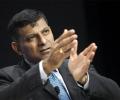
Former RBI governor Raghuram Rajan, who faced a stinging attack from Finance Minister Nirmala Sitharaman for presiding over the "worst phase" of the Indian banking sector, on Thursday reminded her that two-third of his tenure as the head of the central bank was under the Bharatiya Janata Party government.

Days after keeping India's rating at lowest investment grade for 13th year in a row, the rating agency in a webinar said despite the contraction in GDP this year, the country continues to be an outperformer among the peer groups.

Stating that a weak fiscal position continues to constrain India's sovereign ratings, Fitch said the next government's medium-term fiscal policy will be of particular importance from a rating perspective.
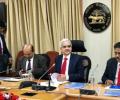
'Overall, domestic demand has moderated significantly. 'The weakening of private consumption, which for long has been the bedrock of aggregate demand, in particular, is a matter of concern,' RBI Governor Shaktikanta Das said in the MPC meetings, in October.

Finance Minister Nirmala Sitharaman presents her fourth Budget in Lok Sabha on Tuesday.
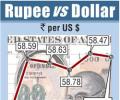
Increased selling of the dollar by banks and exporters amid sustained foreign capital inflows supported the rupee.

The poll of over 30 economists, taken in the past week, showed Asia's third largest economy will expand 7.8 percent in the fiscal year ending March 2017.

Raghuram Rajan said the passage of the GST Bill augurs well for the growing political consensus for economic reforms.

Citing faster-than-expected recovery, rising consumer confidence and the resultant spending spike, Swiss brokerage UBS Securities has revised upwards its growth forecast for the current fiscal to 9.5 per cent from 8.9 per cent in September. The brokerage also sees the economy clipping at 7.7 per cent in FY23 but moderating to 6 per cent in FY24, as it expects the benefit of the low-interest rate regime to end by the end of FY23, and it sees the central bank hiking policy rates by 50 bps in the second half of the next fiscal. The Reserve Bank also forecasts 9.5 per cent GDP growth this fiscal while the average projection ranges from 8.5 to 10 per cent.

A series of steps taken by the government to promote ease of doing business and liberalisation of foreign direct investment norms have helped India receive record FDI inflows so far this year, and implementation of measures like PM Gati Shakti, single window clearance and GIS-mapped land bank are expected to further push investments in 2022. Notwithstanding the global slowdown and the COVID-19 pandemic, total foreign direct investments into India rose to a record $81.72 billion in 2020-21. During April-July this fiscal, FDI (foreign direct investment) into the country increased by 62 per cent to $27.37 billion.

As if wanting to be an antidote to the coronavirus pandemic, the Indian stock market adorned carnival robes in 2021 with a tsunami of liquidity unleashed by global central banks coupled with supportive domestic policies and the world's largest vaccination drive sparking off a world-beating rally on Dalal Street, despite bouts of uneasiness over fizzy valuations. While the wider economy shuttled between recovery and relapse, dictated by multiple mutations of the virus, equity market benchmarks appeared headed in just one direction -- skywards. The dizzying upward journey has added a whopping Rs 72 lakh crore during 2021 to investors' wealth, measured as the cumulative value of all listed shares in the country, taking it to nearly Rs 260 lakh crore.

Rajan said too many infra projects do not have forex earnings thus are unable to pay in dollars or yen

Finance Minister Arun Jaitley said that at a time when the private sector has been somewhat conservative in investments, public investment always takes the lead.

Expectations are high. There is a little bit of euphoria in India, says RBI governor.

In the global context, the country "stands out" in terms of relatively stronger growth and improved economic fundamentals, Raghuram Rajan said.


The country's exports are expected to contract by 5.8 per cent and imports by 11.3 per cent during the second half of the current financial year, though implementation of several measures by the government would help support exports going forward, according to the Economic Survey 2021. With gradual recovery of economic activities, the survey said that imports and exports have picked up. During the first half of 2020-21 (April-September), exports dipped by 21.31 per cent to $125.25 billion while imports declined by 40 per cent to $148.69 billion.
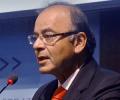
Finance Minister Arun Jaitley on Monday said domestic private sector investments have been slow and high cost of capital was also affecting several sectors.

Raghuram Rajan is said to have informally written to select policymakers and experts, to curb 'unnecessary' speculation over his future at RBI.

They sought further cut in interest rates as well as reforms.

For his first Budget in July 2014, Jaitley inherited a fiscal deficit target of 4.1 per cent of GDP. From 4.1 per cent, the fiscal deficit came down to 3.4 per cent by 2018-19, with two slippages from the budgeted targets, in 2017-18 and 2018-19, the former due to introduction of the GST, says Arup Roychoudhury.

Today, the economy requires a certain amount of push not just from the monetary policy but also from its transmission: Das.

'It is time to allow the rupee to move towards its true value, as it is hurting Indian exports, investment and SMEs associated with export sectors that create jobs,' argues Pravakar Sahoo.

'There are deeper, underlying, forces at work and we need institutional arrangements to guard against them.'

The panel noted that the macro-economic fundamentals of the economy are sound but challenges remain, several of which are structural in nature.

Whereas the headline growth rate appears very respectable, India needs faster to growth to generate jobs.

Two successive reports, one by Percy Mistry in 2007 and the other by Raghuram Rajan in 2008 had provided the RBI and the finance ministry with blueprints of what to do next. Both reports, unfortunately, was put on ice. The global meltdown saved the RBI. It also saved the finance ministry from having to work on the two reports.

Owing to Finance Minister Nirmala Sitharaman being new to her role, a number of crucial announcements in the Budget bore Garg's imprint, especially the decision to borrow in overseas markets, reduce the fiscal deficit as a percentage of gross domestic product, and resort to off-Budget borrowing to meet that target, says Arup Roychoudury.

'Modi must keep his members in check or risk losing domestic and global credibility,' Moody's warned.

A way out of the economic slump is to revisit the template of 15 years ago and follow its constituents, recommends Ajay Shah.
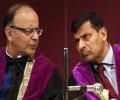
Jaitley was reacting to a question by CNBC TV18 on Rajan's remarks last week.
The rank of COO is the latest in a series of decisions that met with internal resistance at Mint Road and now North Block.

Equity markets braved all odds this fiscal and rewarded investors with high returns as the benchmark Sensex surged more than 66 per cent despite COVID-led disruptions and concerns over its impact on the economy. Market analysts termed FY 2020-21 as a roller coaster ride for not only Indian markets but also for equity indices globally due to the pandemic. In an unprecedented come back, the 30-share BSE Sensex has jumped 19,540.01 points or 66.30 per cent so far this fiscal. This extraordinary rally holds significance as markets faced volatile trends this fiscal.

'This is happening regardless of the Budget.'

The court also allowed Indian Banks' Association, another respondent, to file a response.
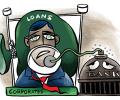
Given Indian corporates's high indebtedness, new credit will be used for servicing loans rather than building factories. This is setting us up for more companies on life support and more zombie banks, warns Rahul Jacob.

13 eminent economists, including former RBI governor Raghuram Rajan and current International Monetary Fund Chief Economist Gita Gopinath, in a report have asked the political establishment not to resort to populist tricks.

Morgan Stanley says, India will clock 7.9 per cent GDP growth in current fiscal.

Rajan said the government focussed more on fulfilling its political and social agenda rather than paying attention to the economic growth.

Finance Minister Nirmala Sitharaman on Tuesday unveiled a Rs 39.45 lakh crore Budget with a view to fire up the key engines of the economy to sustain a world-beating recovery from the pandemic. This was Sitharaman's fourth Budget. While the taxpayers were left in the lurch, once again, was she able to cheer Corporate India?
 © 2026 Rediff.com - Advertise with us - Disclaimer - Privacy Policy - Sitemap - Feedback - About us - Terms of use - Grievances